

About the creation:
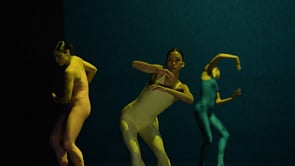
“In the creation process of this work, I felt completely free. I have explored opposing, radically different dance languages whilst working with the music of Julia Wolfe and simultaneously encouraging the dancers to give life to Hanna Kulenty’s GG Concerto. I challenged them to be rhythmically very strict, but at the same time impulsive and playful, so they could bring out all the beautiful textures and phrasing in the compositions.
As I was watching these dancers fool around in the studio, I observed my own pleasure of being surrounded by these extremely talented artists, and the saying “like a kid in a candy shop” came to mind.
One of its definitions is: “Someone feeling overwhelming joy, excitement, and unbridled enthusiasm, often leading to uncontrolled or silly behavior, due to being surrounded by many desirable choices or abundance.” This is exactly how I have felt these past weeks.
Dear audience, I hope this work will also awaken that kind of childlike feeling in you: offering so many beautiful, wild, funny and/or gorgeous movements, instant choices and people to look at; an abundance of life in these dark times.
A huge thanks goes to the deep commitment and artistry of the dancers, to my artistic collaborators and advisors Zora Westbroek, Jan Fedinger, Joris van Oosterwijk, Ennya Larmit, Yolanda Klompstra, Marc Vanrunxt, Renée Copraij, Emily Molnar, and to the huge support of the entire NDT team.
I dedicate this work to Hans Van Manen, who taught me a lot, but above all, to remain playful.”
– Jan Martens


Scott Fowler about KID IN A CANDY SHOP:
“Listening, in Jan’s work, is an active practice. His approach to a musical score has pushed the walls of our brain outward, making space for a new and highly rigorous method of musical embodiment.
Throughout his process, Jan has handed us numerous excel spreadsheets, filled with numbers, colours, and time codes—his own meticulously structured score of the music. As dancers, counting is second nature, but with one look at Jan’s score it was immediately clear that this was far from the typical 5,6,7,8, and was going to demand a new kind of listening.
The beauty of Jan’s method is that, once understood, it actually draws your attention to musical nuance—both for audience and dancer—rather than diminishing it. As a dancer, I’ve always disliked counting, especially while performing, because it draws my attention to timekeeping, rather than truly listening. With Jan, it’s a different story: his notation guides the way we listen, providing a framework for deeper musical understanding.
With the Kulenty score, he has given us extremely strict musical tasks, paired with an abundance of freedom in our movement choices. The dichotomy was at first frightening, and often still is, but as our understanding of the music deepens, the very elements that once felt frightening begin to reveal themselves as playful.”


Gabriele Rolle about KID IN A CANDY SHOP:
“Working with Jan and his team has been such a pleasure – we had a very fun time in the studio and I enjoyed being challenged both physically and mentally.
Music and musicality have been our main focus during the creative process and served as the main drive for our movement exploration.
In Jan’s world, dance and music don’t simply support one another: they become one another and merge into one performative entity – to the point that one of the goals of our dancing is to guide the audience through their listening experience, illustrating details and nuances in the score that might go unnoticed without their movement counterparts.
I find this work to be an extremely challenging, yet rewarding journey. I’m interested in how personal choices give shape to collective images, creating new worlds and possibilities.
I’m excited to keep exploring this universe, its hidden details and colorful nuances.
YEPPAAA!”